
Most odds aggregators do the same thing: collect lines from several bookmakers and display them in a table. That is useful, but it is also the bare minimum. What separates a smart aggregation system from a basic one is not the volume of data it collects — it is what the system does with that data before it reaches the user. Kèo Nhà Cái 95, available at keonhacai95.com, is built around this distinction. The platform does not just surface odds; it organises and contextualises them in ways that make the information genuinely actionable for football fans tracking matches across multiple competitions.
The Difference Between Collecting Data and Processing It
Raw odds data is noisy. On any given matchday, hundreds of fixtures are active across dozens of competitions, each generating continuous line updates from multiple bookmakers. Displaying all of that unfiltered would be overwhelming. The intelligence in a smart system lies in how it processes that volume into something usable.
Filtering by Relevance
Not every fixture on a global matchday is relevant to every user. A smart aggregation system allows filtering by competition, by kickoff window, and by market type — so a fan focused on Southeast Asian leagues can view exactly that subset without wading through European lower-division fixtures they have no interest in.
This seems like a basic feature, but many platforms still present odds in a single undifferentiated feed. The filtering layer is what turns a data dump into a research tool.
Surfacing Market Anomalies
One of the more valuable things a smart system can do is flag when something unusual is happening in the market. If a line moves significantly faster than historical patterns for similar fixtures, or if 1 bookmaker sits notably out of step with the consensus, that discrepancy is worth knowing about. Manually scanning across 10 bookmaker tabs to spot these gaps is impractical. A system designed to surface them automatically saves that work and delivers the insight directly.
Intelligence in How Odds Are Displayed
Movement Indicators Alongside Current Lines
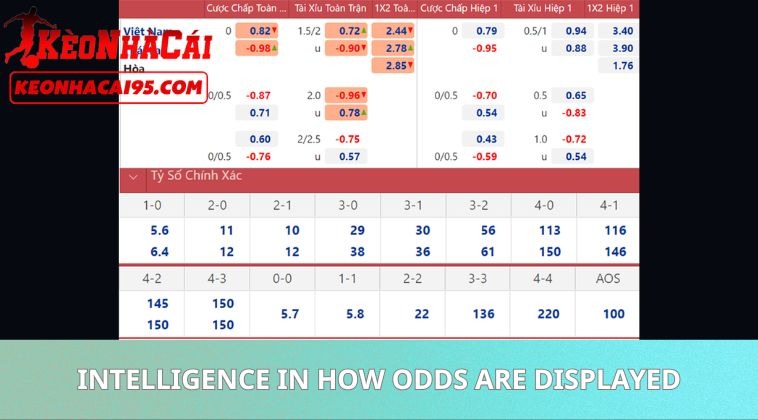
Displaying a handicap figure without context is like showing a share price without the chart. The number tells you where the market is. The direction and velocity of movement tell you how it got there and where it might be heading.
Kèo Nhà Cái 95 incorporates movement indicators that show whether a line has shifted up, down, or held steady since opening — and by how much. A handicap that has compressed from -1 to -0.75 in the hours before kickoff communicates something specific about where market confidence is sitting. That contextual layer is what transforms a static display into a dynamic analytical tool.
Parallel Market Views
Smart aggregation means presenting Asian handicap, total goals, and 1X2 odds for the same fixture in a single view rather than forcing users to navigate between separate pages or tabs. When all 3 market types are visible together, cross-market patterns become apparent. A fixture where the total goals line is rising while the handicap stays flat suggests the market expects a more open game than the spread implies — a nuance that only emerges when you can see both at once.
Bookmaker Comparison Without Manual Work
Comparing odds across bookmakers manually involves opening multiple tabs, noting figures, and keeping track of which source updated most recently. A smart system collapses that process into a single view, presenting each bookmaker’s current line side by side with consistent formatting. Users can identify where the market is aligned and where genuine pricing differences exist without doing any of the cross-referencing themselves.
How the System Handles High-Volume Matchdays
Weekend fixtures in European football can involve 30 to 40 matches running concurrently across major leagues. Adding regional Asian fixtures pushes that number considerably higher. Managing odds data at that volume — in real time, across multiple markets per fixture — requires infrastructure that scales without degrading in speed or accuracy.
Priority Queuing for Active Fixtures
Not all matches need the same update frequency at the same time. A match 72 hours from kickoff does not need second-by-second odds refreshes. A match 30 minutes from kickoff does. A smart system applies priority logic — allocating more frequent updates to fixtures approaching kickoff and dialling back refresh rates for distant fixtures. This keeps the system responsive during high-traffic periods without unnecessary load on lower-priority data.
Handling Simultaneous Kickoffs
When 10 matches kick off at the same time — as happens regularly on Premier League Saturdays — in-play odds for all 10 begin shifting simultaneously. The aggregation system needs to process and display all of those live movements without one competition’s data crowding out another. Efficient queue management and parallel processing architecture are what make this possible at scale.
For a detailed view of how match data and odds are organised across simultaneous fixtures, the full competition schedule and live market display can be explored at https://keonhacai95.com/.
Practical Benefits for Different Types of Users
For the Casual Fan
Even without deep knowledge of how odds markets work, a well-designed aggregation system makes it easier to get a quick read on how a match is being priced. Seeing that a team is a -0.5 favourite across 8 bookmakers with no meaningful variation is immediately informative — the market is aligned and the pricing is stable. No expertise required to interpret that signal.
For the Analytical Follower
Users who track odds as part of a more systematic approach to football analysis benefit from the movement history, cross-bookmaker comparison, and anomaly detection features. These tools turn the platform into a research environment rather than just a reference page — one where patterns can be identified across fixtures, competitions, and time periods.
For the Multi-Competition Tracker
Following 3 or 4 competitions simultaneously is common among Vietnamese football fans who watch European leagues alongside regional fixtures. A smart aggregation system makes this manageable by keeping all competitions accessible within the same interface, organised by kickoff time and filterable by competition — so nothing gets missed during a busy matchday.
Frequently Asked Questions
What makes an odds aggregation system “smart” compared to a standard one?
The distinction comes down to processing and presentation. A standard system collects and displays. A smart system filters, contextualises, flags anomalies, and presents data in formats that support analysis rather than just retrieval.
Does Kèo Nhà Cái 95 show odds movement history?
Yes. Line movement from opening to current is tracked and displayed for significant fixtures, giving users a timeline of how the market evolved rather than just a snapshot of the current figure.
How does the platform manage accuracy during high-volume matchdays?
Priority queuing logic allocates more frequent updates to fixtures approaching kickoff, while parallel processing handles simultaneous live matches without one competition’s data delaying another.
Do I need any technical knowledge to use the platform?
No. The interface is designed to be accessible regardless of how deeply a user understands odds markets. Casual fans get a clear read on market consensus; analytical users get the depth they need through the same interface.
Conclusion
An odds aggregation system earns the label “smart” by doing more than collecting data — it has to organise, filter, and present that data in ways that actually help users understand what the market is saying. Kèo Nhà Cái 95 approaches this with movement indicators, parallel market views, cross-bookmaker comparison, and intelligent handling of high-volume matchdays. Whether you follow football casually or track it analytically, the platform is built to meet you where your interest sits — and give you a clearer picture of the market than any single bookmaker’s feed can provide.