
The prevailing narrative surrounding generative AI often focuses on the “magic” of the prompt. We are told that a well-crafted string of adjectives is the only thing standing between a creative team and a finished campaign. For hobbyists, this is largely true. But for agencies delivering high-stakes visual assets to global clients, the “one-shot” prompt is a myth that dies quickly in the first round of feedback. The reality of production is that raw outputs are rarely, if ever, client-ready. They are starting points high-fidelity sketches that require a rigorous layer of post-production to meet brand standards.
The gap between a visually impressive AI generation and a commercially viable asset is filled with technical debt. It might be a sixth finger, a distorted logo in the background, or an “uncanny” skin texture that feels slightly too synthetic for a high-end beauty brand. When an agency scales, they cannot afford to “re-roll” the dice a hundred times to fix a single artifact. True scalability requires moving away from the lottery of prompting and toward a controlled, surgical pipeline that treats AI outputs as raw material rather than finished products.
The Fragility of the ‘One-Shot’ Prompt Strategy
In a professional setting, “close enough” is a failure. A creative director doesn’t just need a “woman sitting in a cafe”; they need a woman wearing a specific shade of brand-compliant teal, sitting in a cafe that doesn’t have surrealist geometry in the window frames. The inherent variability of diffusion models means that even the most sophisticated prompts are subject to the “90% done” trap. You get the lighting, the mood, and the composition perfect, but a stray object in the corner or a warped facial feature renders the entire image unusable.
This variability creates a massive bottleneck in the review cycle. If a team relies solely on text-to-image generation, they are forced to spend hours chasing the “perfect” seed. This is an inefficient use of talent. Creative leads shouldn’t be gambling with prompts; they should be directing visual outcomes. When the output is treated as a final step rather than a first step, the agency loses control over its own margins. The time spent trying to prompt away a small error is almost always better spent fixing that error directly.
Post-Production as the Professional Anchor
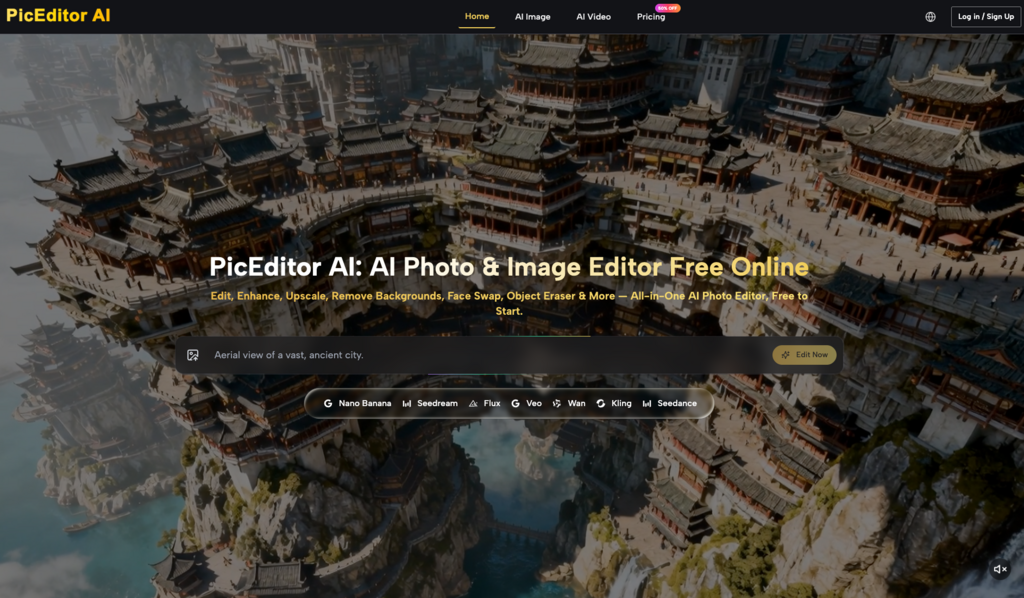
The transition from a “generative” mindset to an “editorial” mindset is what separates successful AI-integrated agencies from those struggling with consistency. Professional production pipelines are now being rebuilt around the idea of the “surgical fix.” Instead of discarding a near-miss generation, teams are utilizing a dedicated AI Photo Editor to bridge the gap between AI potential and professional requirements.
This shift allows for the “salvage” of assets that would previously have been deleted. If the lighting is perfect but the background is cluttered, or if the subject’s expression is slightly off, an AI Photo Editor provides the tools to modify specific regions of the image without altering the elements that already work. This preserves the creative vision while drastically reducing the time-to-delivery. It also changes the nature of the creative role: the “AI Artist” becomes more of a “Finisher,” someone who understands how to take a raw 1024×1026 base and refine it into a 4K, brand-perfect masterpiece.
The Surgical Suite: Object Erasure and Asset Integrity
One of the most common issues in generative media is the “hallucination”—the tendency for AI to add nonsensical details in complex scenes. In a street scene, this might manifest as a car with three headlights or a street sign with unreadable characters. For a client, these details scream “cheap AI.” Removing these artifacts manually in traditional software can be time-consuming, but within an AI-driven workflow, object erasure becomes a primary tool for quality control.
Furthermore, character consistency is a persistent hurdle. If a campaign requires the same model to appear in multiple settings, a simple text-to-image workflow will fail. This is where tools like Face Swap transition from novelty to necessity. By generating a high-quality environment and then precisely mapping the desired character’s features onto the subject, agencies can maintain demographic consistency across a global campaign.
It is worth noting, however, that these tools are not infallible. There is a visible limitation when dealing with extreme angles or occlusions—such as a hand partially covering a face—where the AI might struggle to maintain the structural integrity of the features. Recognizing these “failure states” early is a key part of an operator’s practical judgment. In such cases, an experienced editor knows when to lean on the AI and when to revert to traditional manual retouching.
Managing the Resolution and Texture Gap
Most generative models produce images at a resolution that is acceptable for social media but entirely inadequate for Out of Home (OOH) advertising or high-resolution print. This creates a “resolution debt” that must be paid during post-production. Simply enlarging an image results in pixelation and a loss of the very detail that made the AI generation look realistic in the first place.
Professional upscaling is not just about adding pixels; it is about “re-interpreting” the texture. However, this comes with its own set of risks. Over-smoothing is a common pitfall, leading to skin that looks like plastic or fabric that loses its weave. A production-savvy team knows how to balance noise reduction with the preservation of natural textures. They use specialized models like Flux or Nano Banana to ensure that the upscaled version of the image retains its “photographic” soul.
We must also be honest about the current limitations of automated upscaling. In images with dense, small text or specific architectural patterns, even the best AI upscalers can introduce “worm-like” artifacts or “wobbly” lines. This is where the human eye remains the ultimate quality gate. If the AI cannot resolve a specific texture correctly, the pipeline must allow for a “mask and paint” approach where the editor manually corrects the problematic area while leaving the rest of the upscaled image intact.
Integrating Quality Control into the Repeatable Pipeline
To move at the speed of modern marketing, agencies must formalize their quality control. This means moving away from ad-hoc fixes and toward a “Review-Refine-Release” model. In this pipeline, the Photo Editor AI is not a secondary tool used when things go wrong; it is a central station through which every asset passes before it ever reaches the client’s eyes.
By standardizing this workflow, agencies can reduce the “prompt fatigue” that often plagues creative teams. When designers know they have a robust suite of editing tools from background removal to specialized color grading they feel less pressure to get everything perfect in the initial generation. This paradoxically leads to better creative work, as the team feels freer to experiment with bold compositions, knowing they have the surgical precision to fix the details later.
The ROI of this approach is found in the margins. Every “re-roll” of a prompt is a cost in both compute and human time. Every surgical edit is an investment in a final, billable asset. For agencies building repeatable pipelines, the goal isn’t just to use AI to create; it’s to use AI to finish. The platform that wins is the one that allows a creator to move seamlessly from the broad strokes of generation to the microscopic detail of professional retouching. In the end, the client doesn’t care if the image was generated by an AI; they care if it looks like the brand they spent decades building. It is the job of the modern production pipeline to ensure that it does.