
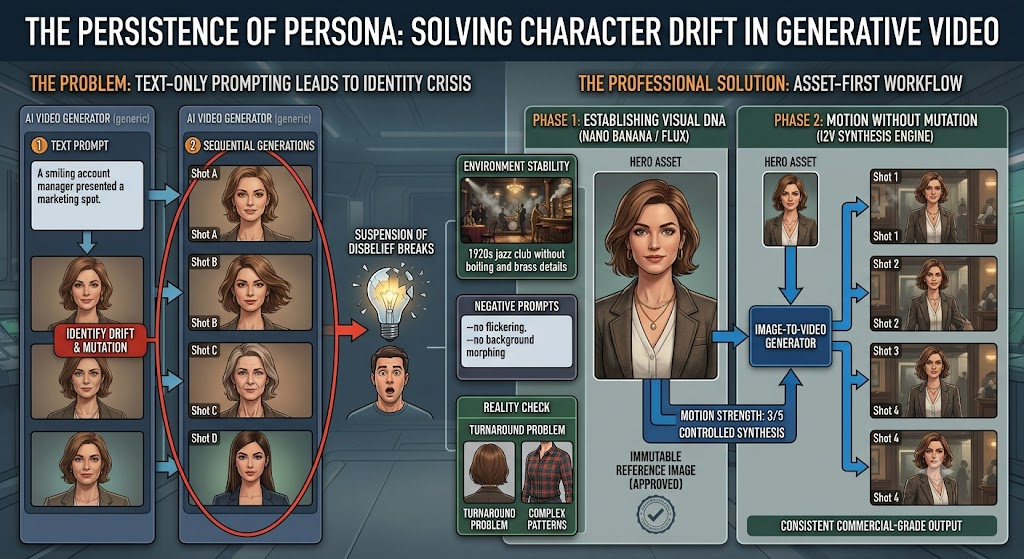
Imagine the scene: an account manager is presenting a thirty-second spot to a major brand client. The lighting is cinematic, the pacing is tight, and the product looks flawless. But halfway through the second sequence, the lead character—the “face” of the campaign—subtly shifts. Her cheekbones sharpen, her eye color deepens, and her hairline moves back an inch. To the client, she is no longer the same person. The suspension of disbelief breaks, and the creative team is back at the drawing board.
This “identity drift” is the single greatest hurdle for agencies moving from experimental AI use to professional client delivery. In the early days of generative media, we were satisfied with “cool” visuals. Now, we are held to the standard of continuity. For an agency to deliver commercial-grade content, consistency cannot be an afterthought or a lucky accident of the seed. It must be treated as a two-stage architectural problem: first, the absolute definition of identity, and second, the controlled synthesis of motion.
The Identity Crisis: Why One-Shot Prompting Fails Agencies
The core of the problem lies in how most creators approach an AI Video Generator. If you enter a text prompt describing a character and hope the model remembers that specific face across five different shots, you are fighting the inherent nature of latent space. These models operate on probabilities, not 3D geometry. Every time you hit “generate,” the model recalculates the most likely arrangement of pixels. Without a hard reference point, it has no “memory” that the character in Shot A must be identical to the one in Shot B.
This leads to the “melting” effect. Characters change ethnicity, clothing textures fluctuate, and jewelry disappears and reappears. From an operational perspective, this is a liability. You cannot build a brand around a character that lacks a stable soul. Even the most advanced AI Video Generator available today often lacks long-term spatial memory if it is fed only text. The solution is to stop asking the video model to “invent” the character and instead start asking it to “animate” a pre-existing asset.

Phase One: Establishing the Visual DNA in Nano Banana
The professional workflow begins not with video, but with a static “hero” image. Think of this as the visual contract. By using a high-fidelity image generator like Nano Banana or Flux, teams can spend the necessary time refining the character’s features until they are locked in. This stage allows for the minute adjustments that a text-to-video prompt simply cannot handle the exact bridge of a nose, the specific shade of a jacket, or the unique texture of hair.
When generating this visual DNA, the goal is clarity and neutrality. A high-resolution portrait or medium shot with balanced lighting serves as the best anchor. If the initial image is too stylized or has extreme shadows, the subsequent video model may struggle to interpret the underlying geometry, leading to artifacts during movement. At this stage, we are not looking for “action”; we are looking for the character’s blueprint. Once this hero image is approved by the creative director, it becomes the immutable reference for every frame that follows.
Motion Without Mutation: The Image-to-Video Pivot
The bridge between a static asset and a dynamic sequence is the image-to-video (I2V) process. Instead of providing a description of a person, you provide the image you just perfected. By feeding this anchor frame into an AI Video Generator, you are giving the model a rigid structural guide. The AI is no longer guessing what the character looks like; it is calculating how that specific person would move through space.
However, this is where technical judgment becomes critical. Most professional platforms allow for “motion strength” or “image fidelity” adjustments. If the motion strength is set too high, the model may take too many liberties with the source image, leading to the very “mutation” we are trying to avoid.
There is a specific threshold often found through iterative testing where the character remains locked while the environment moves naturally. In a platform like MakeShot, using the same seed number across similar shots can help maintain a level of predictability, but the real heavy lifting is done by the reference image itself. Using the AI Video Generator as a motion engine rather than an imagination engine is the fundamental shift required for agency work.
Environment Stability: Preventing the ‘World Warp’
While character consistency is the primary focus, the “world” around the subject can be just as temperamental. We have all seen videos where the background seems to breathe or flicker, a phenomenon often called “boiling.” This occurs when the model tries to re-render background details books on a shelf, trees in a forest with every new frame of motion.
To maintain environment stability, agencies should use negative prompts to specifically exclude “flickering” or “morphing.” Furthermore, keeping the “digital set” consistent requires a descriptive style prompt that remains unchanged even as the action prompt evolves. For example, if the character is walking through a 1920s jazz club, the descriptors for the “smoke-filled room,” “brass fixtures,” and “velvet curtains” should be copy-pasted into every generation. This ensures that while the camera angle might change, the physics and the aesthetic of the world remain grounded. Without this, the character might look correct, but the scene will feel like a green-screen projection gone wrong.

The Reality Check: Boundaries of Current Consistency Tech
It is important to be realistic about where the technology currently sits. We are in a transitional phase where “perfect” consistency is still a moving target. For instance, the “Turnaround Problem” remains a significant hurdle. If you have a reference image of a character’s face and you ask the AI to show them walking away, the model has to “hallucinate” what the back of their head and outfit look like. Until we have models that truly understand 3D volumes, there will always be a moment of uncertainty when a character performs a 360-degree rotation.
Furthermore, complex patterns are the enemy of consistency. A character wearing a solid blue shirt is much easier to keep stable than a character wearing a complex plaid flannel or a specific corporate logo. The AI’s ability to track the geometry of a grid pattern across a moving torso is still hit-or-miss. In these cases, professional teams must be prepared for manual intervention. This might mean choosing camera angles that hide difficult textures or using traditional post-production masking to fix a logo that began to drift during a fast movement. We are not yet at the “press a button for a perfect movie” stage; we are at the “AI-augmented production” stage.
From Generating to Directing: A New Agency Standard
The shift from one-shot prompting to an asset-first pipeline is more than just a technical workaround; it is a change in the creator’s role. We are moving away from the “luck-based” generation where we hope for a good result after fifty tries. Instead, we are building repeatable workflows where the visual assets are centralized and the motion is directed.
The economic advantage of this approach is clear. Agencies that can guarantee character consistency can sell longer-form content and multi-part campaigns. By housing image seeds, hero assets, and video synthesis engines in a single platform, a creative team can build a library of “digital actors” ready for any script. Consistency isn’t a feature you toggle on; it’s a workflow you build.
As the tools continue to evolve, the teams that master the art of the reference frame will be the ones that define the next era of commercial media. The goal is no longer just to create something that looks like a person, but to create a persona that persists.