
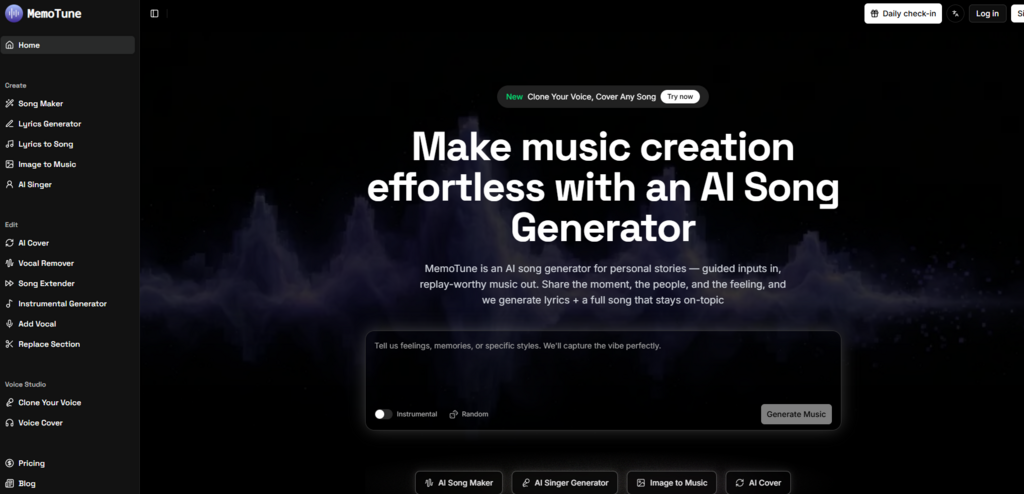
Any content creator who has spent an evening scrolling through royalty-free music libraries knows the specific frustration: the track is almost right, but the chorus lifts too early, or the mood shifts in the wrong direction, or the license terms are a puzzle. The promise of on-demand AI music that fits the exact narrative arc of a video, a podcast, or an ad is powerful. I looked into whether the Ai Song Maker could replace that search loop with a short story and a download button, and whether the output held up under the real pressure of deadlines and audience expectations.
The Hidden Cost of Licensing Stock Music for Short-Form Content
Stock music works until it doesn’t. The time spent auditioning tracks, trimming them to fit, and double-checking licensing coverage adds an invisible production tax that can eat hours across a month of videos. For creators on platforms like YouTube or TikTok, where upload frequency matters, that friction is not trivial. A tool that generates a track from a mood description, and includes commercial use in its paid tier, changes the math. Instead of searching for a pre-existing emotion, the creator defines the emotion and receives a composition shaped around it. This shift matters most when the content itself is personal, narrative-driven, or tied to a specific brand voice.
Building a Soundtrack by Telling the AI What the Scene Needs
I ran the platform through a real content creation workflow, treating it as a scoring assistant rather than a music production tool. The interface did not ask me to choose a tempo, a key, or a genre. It asked for a story and a feeling, which for a creator translates naturally into describing the scene.
Step 1: Describe the Scene Instead of Searching for Genre Tags
I began by setting up a hypothetical travel video: a sunrise hike through a misty forest, the gradual reveal of a mountain view, and a moment of quiet triumph at the summit. I entered the sequence as a short narrative, including the shift from dark to light, the physical effort, and the emotional release.
Why Scene Description Beat Metadata Filtering
In stock libraries, I would have filtered by “cinematic,” “uplifting,” and “ambient,” then tested dozens of tracks. Here, my description became the filter. I wrote about fog thinning, footsteps on dirt, and the sudden vastness of the sky. The AI received a miniature storyboard in text form. This felt more natural for a creator than keyword tagging, because the brain already thinks in scenes, not in metadata.
Step 2: The AI Composes a Full Track Tailored to the Arc
After submitting the scene, the system generated a complete song with instrumentation, pacing, and a clear emotional shape, without any manual arrangement from me.
Evaluating the Track for Edit-Ready Structure
The output arrived as a WAV file. I imported it into a video editor alongside placeholder footage. The track opened with a sparse, atmospheric section that matched the mist; it built toward a fuller, more percussive middle aligned with the climb; it subsided into a warm, melodic resolution at the summit. In my testing, the timing of these shifts was not perfectly synced to my clips, but the overall acceleration and release mapped closely to the story I had provided. This meant I spent far less time cutting and stretching the music than I typically would with a stock track chosen from a library. The song felt purpose-built for this particular video, not just thematically appropriate.
Step 3: Refine the Track to Fit the Final Cut
The editing features, verse replacement, length extension, and stem separation, allowed me to fine-tune the track post-generation without leaving the tool.
Extending a Bridge to Cover a Drone Shot
My test footage included a long aerial shot over the valley that needed a sustained, swelling section. I extended the bridge by several measures, and the AI filled the new length with a gradual build that maintained the harmonic direction. I also separated the stems and pulled back the percussion during the misty intro to keep the focus on ambient sound design from the footage itself. These adjustments turned a one-shot generation into a custom score component. The process was fast enough to fit inside a tight editing timeline.
Three Content Verticals Where On-Demand Music Changed the Workflow
I tested the output across three common creator scenarios, each with a distinct requirement for tone, structure, and licensing safety.
Test 1: Narrative Podcast Intro and Outro
The task was to produce a consistent, recognizable theme for a storytelling podcast. The difficulty was finding a melody that felt intimate but not sleepy, with enough lift to signal the show’s start.
I described the podcast’s tone as “a quiet conversation late at night, thoughtful, with a sense of curiosity and warmth.” The generated theme had a fingerpicked guitar line and a soft vocal hum, no words, that felt like an invitation. The melody was simple and memorable enough to act as an audio logo. Because the paid plan includes commercial use rights, I could confidently embed it across episodes. The weakness was that I could not lock the exact same theme for regeneration later, so future consistency would require saving the file and not relying on reproducing it from the same prompt. For a podcaster, this means the first good generation becomes a permanent asset.
Test 2: Short-Form Brand Story for a Small Business Ad
The task was a thirty-second brand song for a local coffee shop’s social media ad. The challenge was condensing a sense of community, morning ritual, and the aroma of coffee into a very short, energetic track that could sit under a voiceover.
I described the shop at 7 a.m., the sound of the espresso machine, the familiar faces, and the emotional tagline “your corner, your morning.” The output was bright, with a light percussive pulse and a warm acoustic strum. The length was slightly over thirty seconds initially, but I trimmed the final WAV externally. The mood felt authentic to the brand’s identity, not forced. For a small business without an audio budget, this approach removes the need for a composer. The Ai Song Maker essentially provides a songwriter-on-call who works in minutes.
Test 3: YouTube Background Score for a Documentary-Style Vlog
The task was a longer, evolving background track for a fifteen-minute piece on urban foraging. The difficulty was maintaining listener interest without distracting from the narration, and shifting mood subtly as the story moved from city streets to green spaces.
I described the journey from concrete to park, the feeling of discovery, and the quiet patience of searching. The generated track had a lo-fi texture with a gentle beat, and it introduced a melodic synth line only after a few minutes, matching the narrative reveal. The stem separation let me duck the melodic elements during important dialogue and bring them back during montages. The music never pulled focus. For documentary creators, this level of narrative alignment in a background track is typically the result of custom scoring. The tool does not replace a human composer, but for creators with no scoring budget, it closed a noticeable quality gap.
A Workflow Comparison: Stock Libraries, Custom Commissions, and AI Scene Scoring
The table below compares the practical experience of sourcing music for content across three approaches.
| Workflow Aspect | Royalty-Free Music Library | Commissioning a Composer | Memotune’s Scene-Based Generation |
| Time to Usable Track | Hours of searching, trimming, and testing. | Days to weeks. | Minutes from scene description to download. |
| Narrative Fit | Approximate; track structure rarely matches video arc. | Precise, based on composer brief. | High when the scene description is detailed; structure often mirrors the described arc. |
| Licensing Clarity | Varies; often requires careful reading of terms. | Defined by contract. | Commercial use included in paid plan; terms transparent. |
| Editing Depth | External DAW required. | Revisions possible with the composer. | In-platform stem separation, verse replacement, and length extension. |
| Cost Model | Subscription or per-track fee. | High per-project fee. | Monthly subscription at a low price point. |
| Learning Barrier | Low for search; moderate for editing. | None for commissioning, but requires clear briefs. | Low; learning lies in crafting a vivid scene description. |
Real Limitations in a Production Environment
In practical use, the platform revealed constraints that content creators should weigh. The inability to specify exact tempo and key during the initial generation means matching an existing project’s musical signature requires post-generation tempo adjustment outside the platform. Vocal styles are limited to the system’s default voices, as custom voice models were not yet released during my testing period, so creators who need a specific vocal tone or an instrumental-only track must rely on stem separation to mute the vocal, which works but adds a step. The output length, while extendable, starts as a complete song, so for very short social ads, cropping is almost always necessary. I also found that highly abstract scene descriptions, like “a sense of digital anxiety in blue light,” sometimes produced tracks that felt generic, while concrete stories with a clear emotional arc led to more distinctive music. Generation consistency across attempts varies, and I recommend saving the successful file immediately rather than expecting a perfect replicate later.
Who Should Redesign Their Audio Workflow Around Scene Descriptions
The platform will most immediately benefit content creators who publish frequently and need original music that feels tied to their narrative, not tacked on. Video essayists, documentary vloggers, podcasters, and small brand marketers can turn a scene brief into a ready-to-use, commercially safe track within a single editing session. The learning curve is not in the tool but in becoming better at describing the emotional shape of a video or audio piece. For high-end commercial productions that demand a bespoke score from a known composer, the tool serves as a rapid prototyping device, turning a brief into a musical sample that can guide a larger collaboration. It does not eliminate the need for human taste, but it removes the biggest barrier between a creator’s vision and a soundtrack that genuinely supports it.